
Researchers demonstrated a 120-kilowatt wireless power transfer at the National Transportation Research Center, a U.S. Department of Energy Office of Science User facility at Oak Ridge National Laboratory. From left to right above are ORNL’s Saeed Anwar, Burak Ozpineci, Gui-Jia Su, and David Smith; DOE Vehicle Technology Program’s Lee Slezak; and ORNL’s Veda Galigekere, Omer Onar, and Jason Pries. (Photo courtesy ORNL)
By Stephanie Seay/ORNL
Researchers at Oak Ridge National Laboratory have demonstrated a 120-kilowatt wireless charging system for vehicles—providing six times the power of previous ORNL technology and a big step toward charging times that rival the speed and convenience of a gas station fill-up.
The wireless system transfers 120 kilowatts of power with 97 percent efficiency, which is comparable to conventional, wired high-power fast chargers. In the laboratory demonstration, power was transferred across a six-inch air gap between two magnetic coils and charged a battery pack.
ORNL researchers created and demonstrated the world’s first 20-kilowatt wireless charging system, which is being modified for applications such as commercial delivery trucks.
“It was important to maintain the same or smaller footprint as the previous demonstration to encourage commercial adoption,” said project lead Veda Galigekere of ORNL’s Power Electronics and Electric Machinery Group.
“We used finite element and circuit analyses to develop a novel co-optimization methodology, solving the issues of coil design while ensuring the system doesn’t heat up or pose any safety issues, and that any loss of power during the transfer is minimal,” he said.
To achieve 120 kilowatts, the ORNL team created a new coil design co-optimized with the latest silicon carbide power electronic devices for a lightweight, compact system.
The system’s architecture takes energy from the grid and converts it to high-frequency alternating current, which generates a magnetic field that transfers power across a large air gap. Once the energy is transferred to the secondary coil, it is converted back to direct current and stored in a vehicle’s batteries.
The demonstration advances DOE’s extreme fast-charging goal to develop a system that delivers 350 to 400 kilowatts and reduces the charging time for electric vehicles to 15 minutes or less.
“This breakthrough significantly advances the technology needed to encourage greater adoption of electric vehicles by increasing their range and the ease of recharging, and in turn supports an energy-efficient mobility system for the nation’s economic success,” said Moe Khaleel, associate laboratory director for Energy and Environmental Sciences at ORNL.
ORNL researchers will explore innovations to increase power transfer level to 200 and eventually 350 kilowatts, while refining dynamic wireless charging technology. A dynamic system enables the automatic charging of electric vehicles using wireless charging pads installed under roadways. Higher power charging systems are needed to minimize the cost and complexity of dynamic charging.
“The goal is dynamic charging at highway speeds,” Galigekere said.
The research was funded by the U.S. Department of Energy’s Vehicle Technologies Office (VTO) and performed at the National Transportation Research Center, a DOE user facility at ORNL. The VTO, part of DOE’s Office of Energy Efficiency and Renewable Energy, invests in early-stage research to enable private-sector development and commercialization of affordable, energy efficient transportation technologies that can strengthen energy security, support U.S. economic growth, and offer consumers and businesses additional transportation choices.
More information will be added as it becomes available.
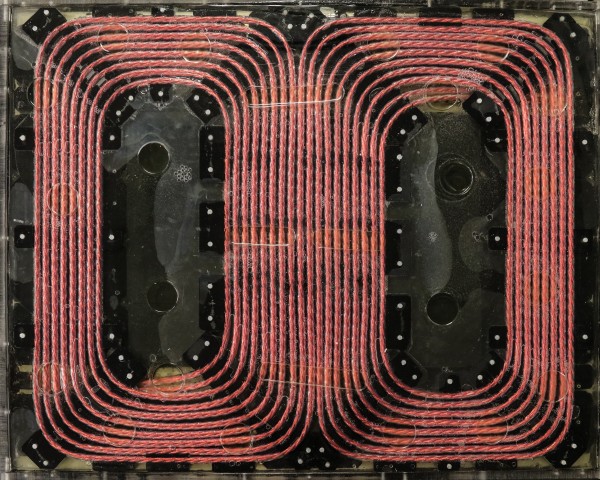
Oak Ridge National Laboratory researchers used computer simulations to design coils that generate the magnetic field required for wireless power transfer. (Photo courtesy ORNL)
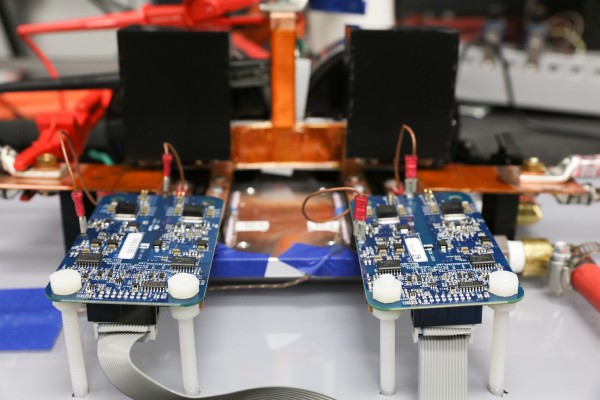
State-of-the-art power electronics manage the safe and efficient flow of electricity among the system’s components. (Photo courtesy ORNL)
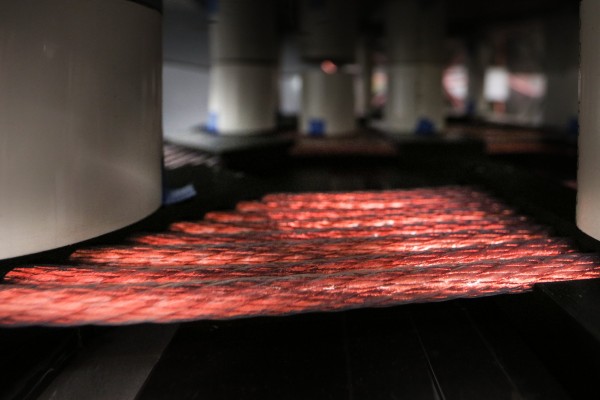
Oak Ridge National Laboratory’s unique wireless coils and power electronics are co-optimized to safely transfer large amounts of electricity across an air gap at 97 percent efficiency. (Photo courtesy ORNL)
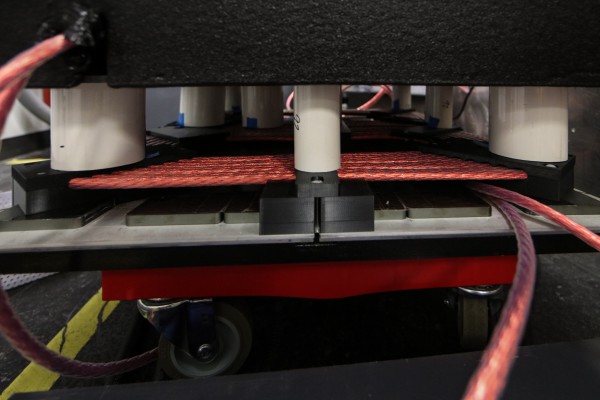
Oak Ridge National Laboratory’s unique wireless coils and power electronics are co-optimized to safely transfer large amounts of electricity across an air gap at 97 percent efficiency. (Photo courtesy ORNL)
Most news stories on Oak Ridge Today are free, brought to you by Oak Ridge Today with help from our advertisers, contributors, and subscribers. This is a free story. Thank you to our advertisers, contributors, and subscribers. You can see what we cover here.
Do you appreciate this story or our work in general? If so, please consider a monthly subscription to Oak Ridge Today. See our Subscribe page here. Thank you for reading Oak Ridge Today.
Copyright 2018 Oak Ridge Today. All rights reserved. This material may not be published, broadcast, rewritten, or redistributed.






Leave a Reply